

The Woman Who Tried to Steal Graceland
Forged signatures, a phantom company, a hijacked notary seal and the
astonishing plot to auction Elvis Presley’s home
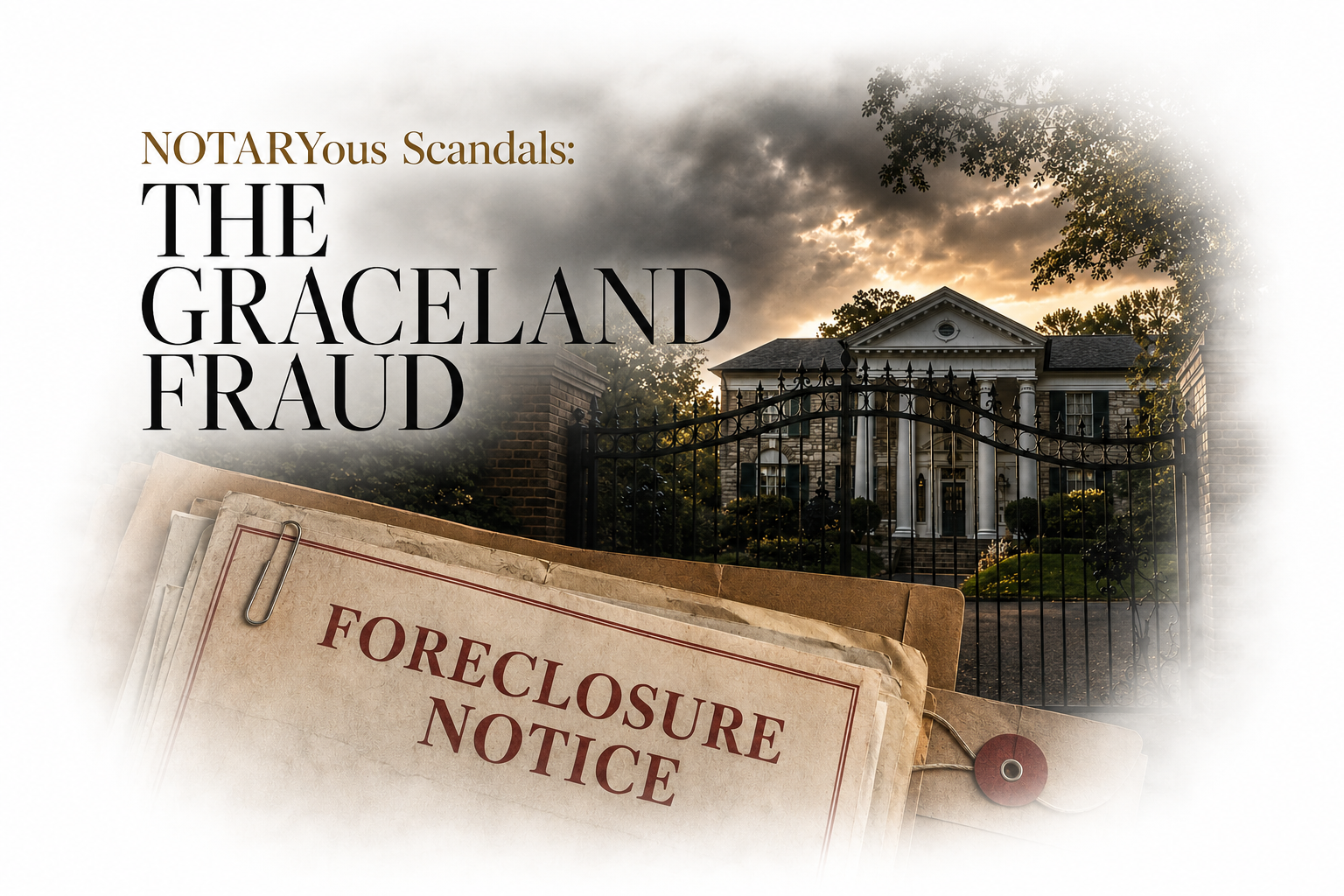
The Graceland fraud began with a loan that never existed and came within one day of sending Elvis Presley’s home to public auction.
The notice appeared with all the emotional warmth of an execution order.
Graceland would be sold at public auction.
The date was May 23, 2024. The location was the front steps of the Shelby County Courthouse in Memphis. The terms were brutally simple:
Highest bidder. Cash.
There would be no velvet ropes. No guided tour through the Jungle Room. No solemn procession past Elvis Presley’s grave.
Just a foreclosure sale.
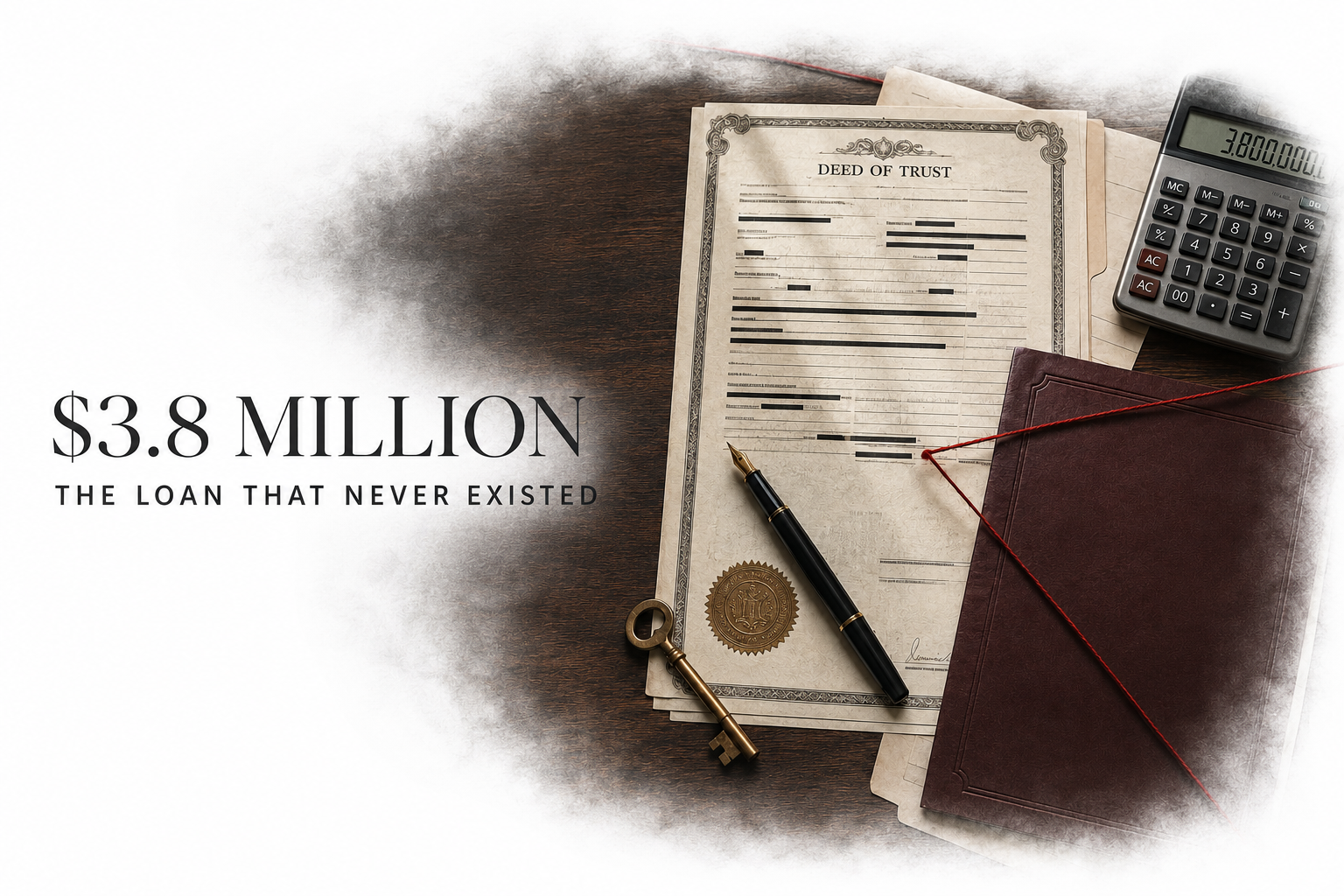
According to the paperwork, Lisa Marie Presley had borrowed $3.8 million from a private lender in 2018 and pledged Graceland as collateral. She had allegedly died without repaying the debt.
Now the lender wanted its money.
Or it wanted the most famous private home in America.
There was only one problem.
The loan did not exist.
The lender did not exist.
And the woman accused of creating both apparently believed that if she assembled enough official-looking paperwork, invented enough people and pushed the machinery of foreclosure into motion, someone might actually hand her millions of dollars to make her go away.
This was not merely an attempt to scam the Presley family.
It was an attempt to steal Graceland in broad daylight.
How the Graceland Fraud Began With a Ghost Company
The company calling itself Naussany Investments & Private Lending LLC emerged with a remarkable claim.
Before her death in January 2023, Lisa Marie Presley had supposedly accepted a $3.8 million loan and signed a deed of trust placing Graceland at risk if she failed to repay it.
Naussany did not initially demand the full amount.
It offered to settle for $2.85 million.
That number was not random. It was exactly 75 percent of the alleged loan, a large enough discount to create urgency while remaining an extraordinary payday.
The message to the Presley family was essentially this:
Pay us millions now, or risk losing Graceland in public.
The demand arrived during a period of profound vulnerability.
Lisa Marie had died suddenly at 54. Her daughter, actress Riley Keough, had become trustee of the family trust. Graceland was not simply an expensive piece of real estate.
It was her family home.
It was her grandfather’s burial place.
It was her mother’s final resting place.
It was also one of the most recognizable cultural landmarks on Earth.
The woman later accused of orchestrating the scheme, Missouri resident Lisa Jeanine Findley, appears to have seen something else.
An estate in transition.
A dead borrower who could not deny signing anything.
A grieving heir under pressure.
And a property so valuable that a multimillion-dollar settlement might seem cheaper than allowing even a fraudulent claim to reach auction.
The cruelty was not incidental to the plan.
It was part of the leverage.
The Company Had Employees. None of Them Were Real.
Naussany Investments presented itself as a private lender staffed by people with names such as Gregory Naussany and Kurt Naussany.
Federal prosecutors later said those individuals were personas used by Findley.
She did not merely invent a company.
She populated it.
Using different names and email accounts, she allegedly created the illusion that several people were communicating on behalf of an established financial business.
Her known aliases included:
- Lisa Holden
- Lisa Howell
- Lisa Jeanine Sullins
- Carolyn Williams
- Gregory Naussany
- Kurt Naussany
It was financial theater performed by a remarkably small cast.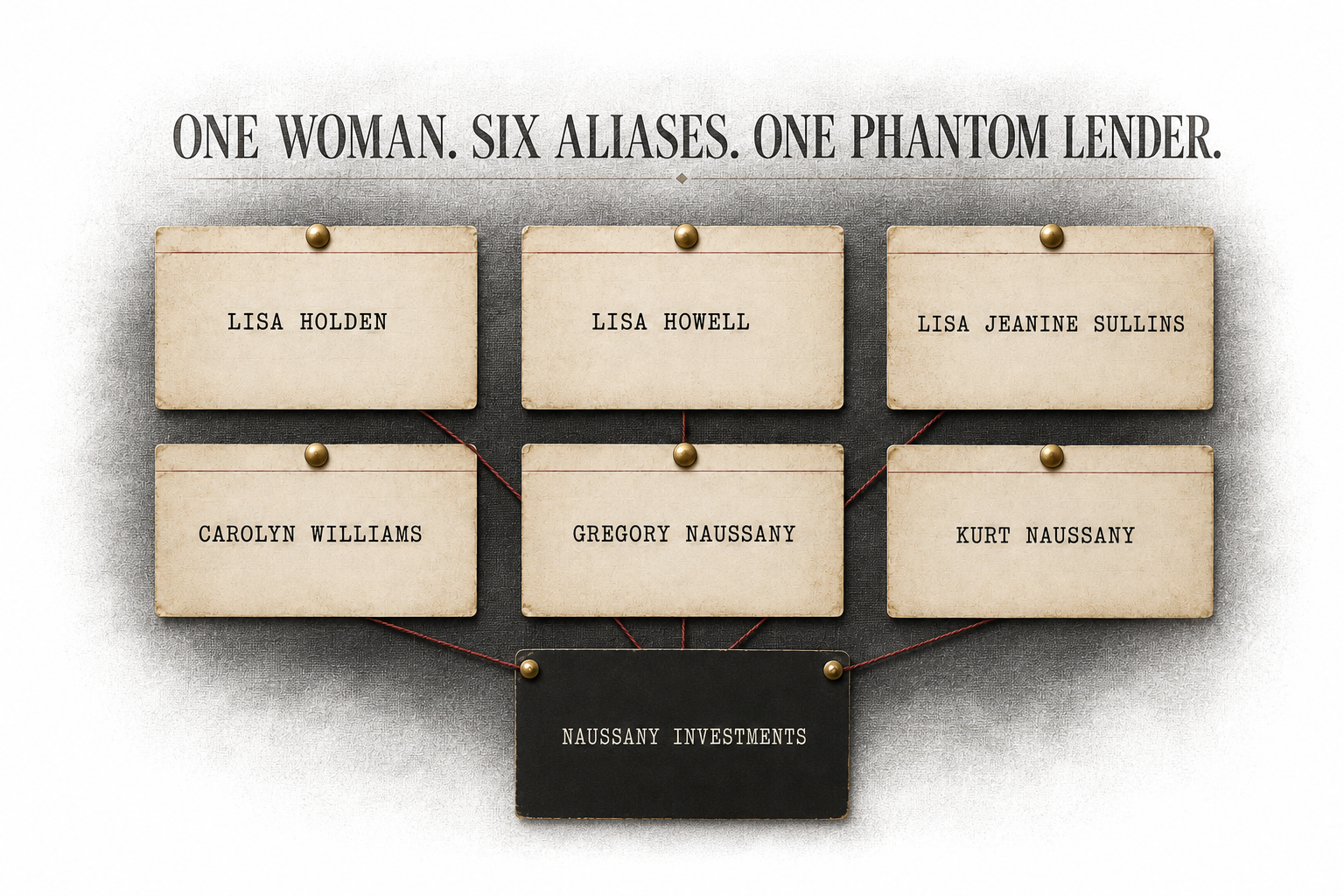
The illusion began to collapse under basic scrutiny.
Reporters could not locate a legitimate company registration for Naussany Investments. Its listed telephone number was out of service. Emails sent to the supposed business sometimes produced an automated out-of-office reply, as though the phantom lender maintained ordinary office hours.
Investigators eventually connected the façade back to Findley.
According to the federal criminal complaint, contact information used in the creditor claims was linked to her. An email associated with the company’s phone number was connected through Google Pay to bank accounts in her name. The email used to submit the foreclosure notice was tied to an alias she had previously used.
The company was fictional.
Its digital fingerprints were not.
The Signature That Almost Stole a Kingdom
At the center of the scheme were documents that appeared to bear Lisa
Marie Presley’s signature.
But a forged borrower’s signature alone was not enough.
Documents placing real estate under a deed of trust must appear properly executed. That meant the paperwork needed something capable of transforming an ordinary forgery into an official-looking legal instrument.
It needed a notary.
The documents named Florida 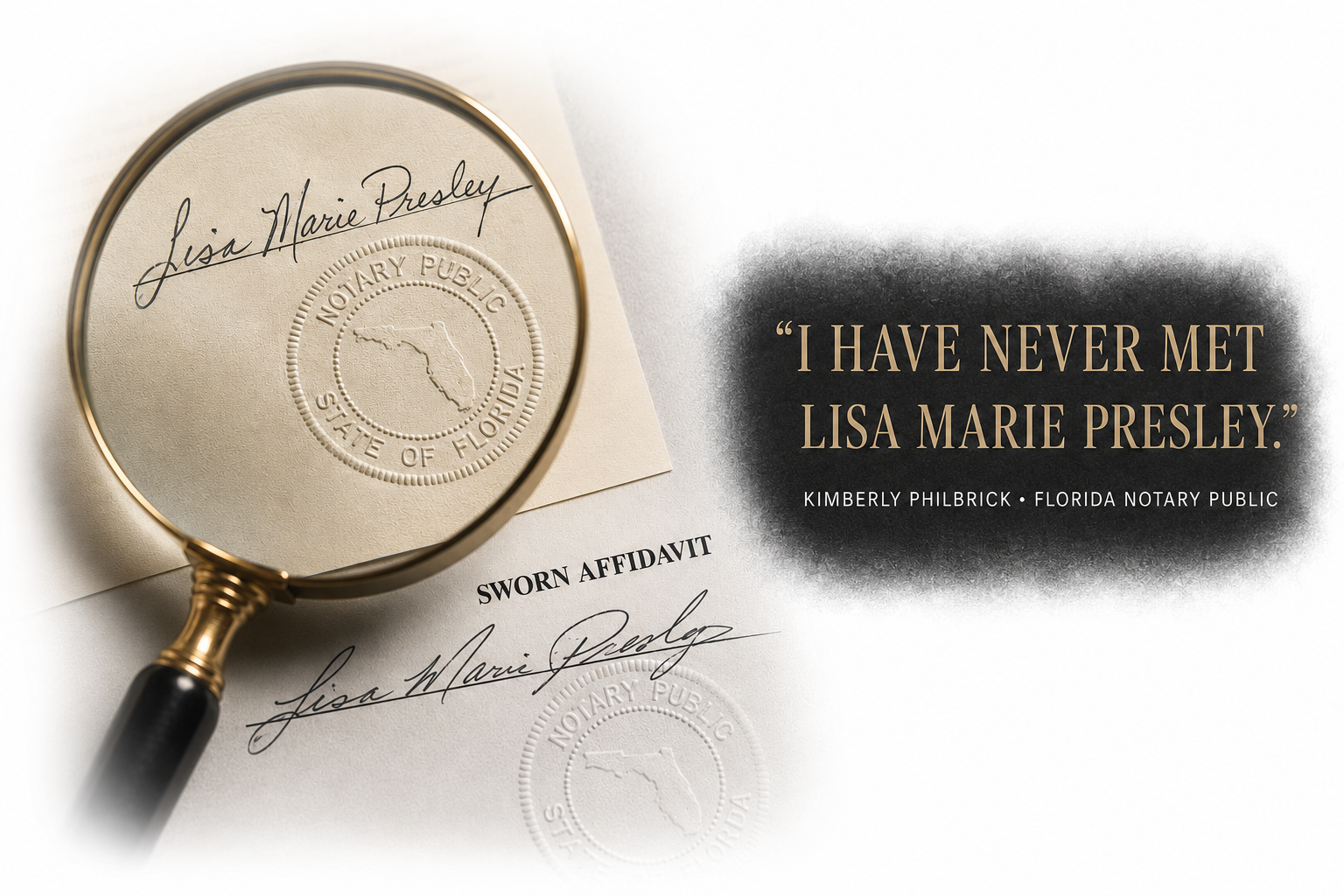 notary Kimberly Philbrick and displayed what appeared to be her signature and official seal.
According to the paperwork, Philbrick had notarized Lisa Marie Presley’s signature in Jacksonville, Florida, in 2018.
Philbrick later swore that she had never met Lisa Marie Presley and had never notarized a document for her.
There was another quietly devastating detail.
Philbrick worked approximately 90 miles from Jacksonville and said she had little reason even to visit the city where the supposed notarization occurred.
The scheme’s most convincing stamp of legitimacy became one of the clearest pieces of evidence against it.
A notary seal can look like bureaucratic decoration, something most people barely notice at the bottom of a page.
In this case, it became the weak seam that allowed the entire fiction to be pulled apart.
Philbrick did not need to perform forensic handwriting analysis or unravel a complex financial trail.
She simply had to say:
That is my name, but I did not do this.
One woman’s stolen identity had been used in an attempt to steal another dead woman’s home.
And the living woman could still testify.
The Scam Did Not Remain Inside an Inbox
Many fraud attempts die when the recipient refuses to respond.
Findley’s scheme became more dangerous because it moved beyond threatening emails and entered real institutions.
False creditor claims were filed in a California court.
A fraudulent deed of trust was submitted in Memphis.
A foreclosure notice was placed in The Commercial Appeal, a legitimate Memphis newspaper.
The notice announced that Graceland would be sold to the highest bidder for cash.
This is one of the strangest aspects of the story.
The person behind the scheme did not need to corrupt every institution involved. She merely needed ordinary systems to process the materials placed before them.
A newspaper may publish a legally formatted notice without independently retrying the underlying debt.
A recording office may accept a document that appears complete on its face.
A foreclosure process can begin moving before every signature has been authenticated.
The plot exploited the enormous difference between filing a document and proving that the document is true.
Once the foreclosure notice appeared publicly, the fiction gained something precious:
The appearance of reality.
News organizations reported the coming sale. Elvis fans panicked. The world began asking how Graceland could possibly be lost over an unpaid loan.
For a few extraordinary days, the fake foreclosure became a real international news story.
Riley Keough Had Days to Stop It
Riley Keough did not quietly pay the demanded settlement.
She sued.
On May 15, 2024, acting as trustee of the Promenade Trust, Keough filed a complaint in Tennessee alleging that the loan documents were fraudulent.
The lawsuit claimed that Naussany Investments appeared to be a fake entity created to defraud the trust, Lisa Marie Presley’s heirs or a potential purchaser at the auction.
The scheduled sale was only eight days away.
On May 22, just one day before Graceland was supposed to be offered on the courthouse steps, Chancellor JoeDae Jenkins blocked the foreclosure.
The mansion remained with the Presley family.
Then the mysterious lender abruptly retreated.
What had been presented as an enforceable multimillion-dollar debt began dissolving the moment it was forced to withstand direct judicial scrutiny.
There would be no dramatic bidding war for Graceland.
No stranger would emerge from the courthouse with a receipt for Elvis’s home.
But the retreat did not end the story.
It changed the genre.
What began as a bizarre property dispute became a federal criminal investigation.
Then Came the “Nigerian Identity Thief”
As worldwide attention closed in, someone claiming responsibility for the plot contacted the media and presented a sensational explanation.
The scheme had supposedly originated with an identity-theft operation in Nigeria that specialized in targeting dead and elderly Americans.
It was the perfect fog machine.
The story introduced an international criminal ring, distant conspirators and the familiar specter of an untraceable overseas scammer.
It also diverted suspicion away from anyone closer to the documents, addresses and accounts being examined in the United States.
Federal prosecutors later accused Findley of sending messages to the Presley family’s representatives, the court and the media that falsely blamed a Nigerian identity thief.
In other words, the purported confession from abroad was not the solution to the mystery.
It was allegedly another layer of the con.
The woman accused of inventing a lender, its employees and its debt had apparently invented one final character to take the fall.
The Paper Trail Led to Missouri
On August 16, 2024, federal authorities arrested Findley.
Prosecutors charged her with mail fraud and aggravated identity theft.
They alleged that she had orchestrated the attempted foreclosure, fabricated loan documents, forged signatures, filed false claims and tried to extract $2.85 million from the Presley family.
In February 2025, Findley pleaded guilty to one count of mail fraud. The aggravated identity-theft charge was dropped as part of the plea agreement.
At sentencing, the defense argued that the plan had been too unrealistic to succeed.
It was an extraordinary position:
The scheme was supposedly so audacious that its implausibility should count in Findley’s favor. The judge was not persuaded.
In September 2025, Findley received 57 months in federal prison, followed by three years of supervised release. She declined to speak before the sentence was imposed.
The judge characterized the operation as both brazen and highly sophisticated.
The Presley family lost neither Graceland nor the demanded millions.
But the lack of financial loss should not disguise how far the scheme traveled.
It penetrated courts, property records, a major newspaper and the machinery used to transfer ownership of real estate.
It reached the courthouse steps before anyone stopped it.
The Wildest Little-Known Facts About the Graceland Fraud
Perhaps the most unsettling details are not the most cinematic ones.
The alleged lender was entirely fictional
Naussany Investments was presented as a legitimate private lender even though investigators and journalists could find no evidence that the company genuinely existed.
One person allegedly played several company representatives
Different names and email accounts created the illusion that multiple employees were communicating on behalf of the lender.
The settlement demand was carefully calculated
The requested $2.85 million represented exactly 75 percent of the alleged $3.8 million loan.
The discount made the fake debt appear negotiable and gave the Presley family a financial incentive to settle quickly.
The notary was nowhere near the supposed transaction
The documents claimed that Kimberly Philbrick notarized Lisa Marie Presley’s signature in Jacksonville.
Philbrick denied ever meeting Lisa Marie and said she did not work in Jacksonville.
A legitimate newspaper made the fake foreclosure feel real
Once the public notice appeared in The Commercial Appeal, the claim no longer looked like a strange email scam.
It looked like a pending legal event.
The auction was stopped only one day before it was scheduled
Had Riley Keough and her attorneys waited, the situation could have become even more complicated.
The supposed overseas confession was allegedly another deception
The Nigerian identity-theft story initially appeared to explain the mystery. Prosecutors later claimed it was an attempt to direct suspicion away from Findley.
Graceland’s fame may have saved it
A forged claim against an ordinary homeowner might not attract serious attention until a title was clouded or a sale had already been attempted.
A foreclosure against Graceland summoned lawyers, reporters, investigators, public officials and millions of suspicious Elvis fans.
Findley may have selected the ultimate prize.
She also selected the loudest possible alarm.
Graceland Was Never the Only Target
It is tempting to treat this story as celebrity true crime, a once-in-a-lifetime caper made irresistible by Elvis Presley’s name.
That would be a mistake.
The scheme exposed something much larger than the security of one mansion.
American property systems still rely heavily on documents, signatures, notarial certificates and recording procedures that can be imitated.
Recorders generally accept documents for filing. They do not conduct full criminal investigations into every deed that crosses the counter.
Public notices can trigger fear before the underlying claim has been tested.
Dead property owners cannot dispute signatures.
Grieving relatives may not immediately recognize every debt in an estate.
Most victims do not have Graceland’s visibility.
They do not have an entertainment company issuing statements, a famous granddaughter retaining attorneys or reporters calling every address associated with an alleged lender.
They may discover the fraud only after a lien has clouded the title, a sale has been attempted or an impostor has extracted a payment.
That is the true horror hiding beneath the absurdity.
Someone tried to steal Elvis Presley’s home using a fake loan, a stolen notary seal and a company that existed largely in email addresses.
The plan failed because a family fought back, a notary spoke up and the world was watching.
But Graceland was not protected by magic.
It was protected just in time.
And somewhere beyond its famous gates, another forged document may already be waiting to see whether anyone notices.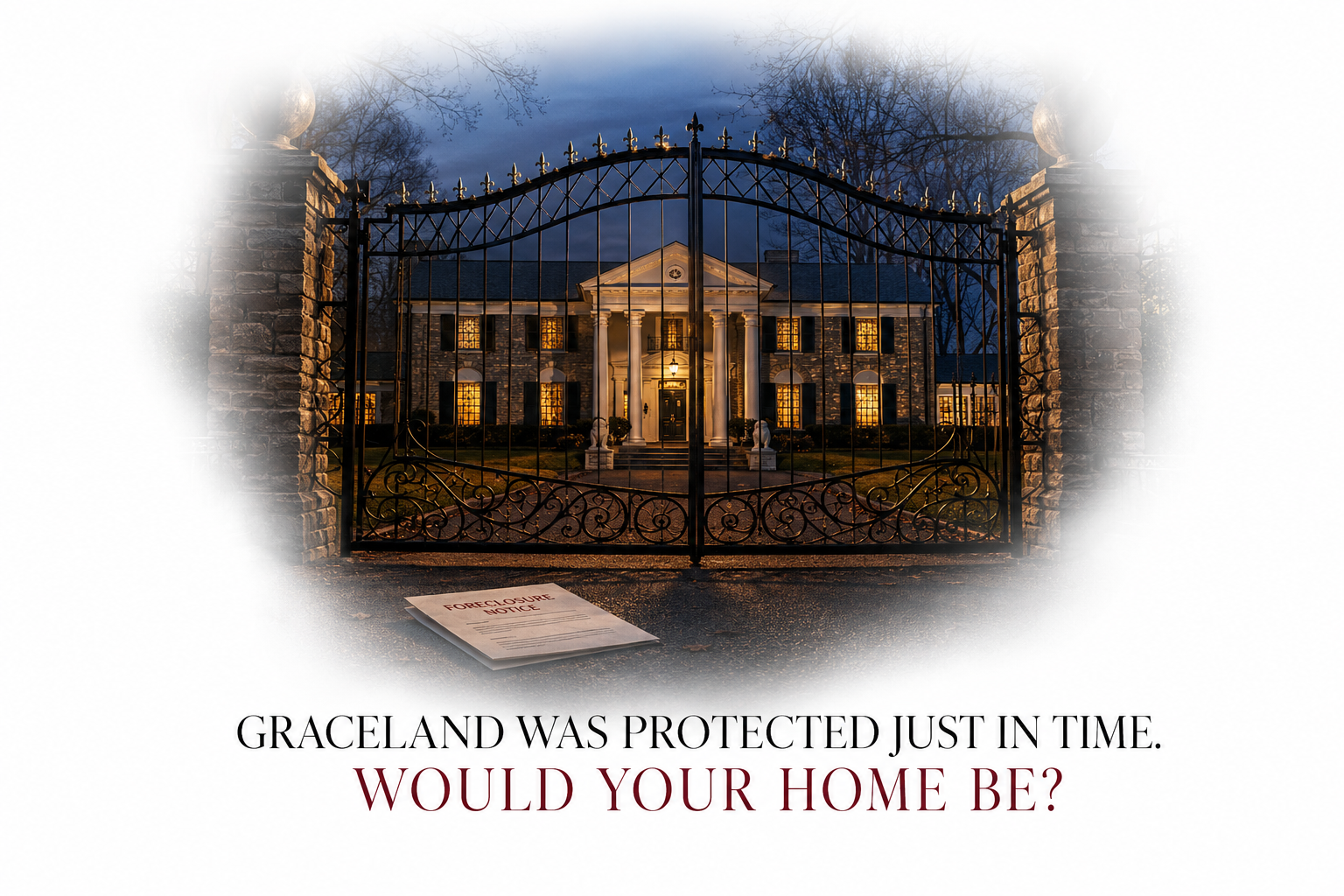
Sources and Further Reading
- U.S. Department of Justice: Woman Charged in Scheme to Defraud Elvis Presley’s Family
- U.S. Department of Justice: Missouri Woman Sentenced in Graceland Foreclosure Scheme
- Associated Press: Woman Sentenced for Trying to Sell Graceland
- Reuters: Woman Sentenced for Trying to Steal Graceland
This article is based on court filings, federal charging documents, statements from the U.S. Department of Justice and published reporting. Allegations are described as allegations where applicable. Lisa Jeanine Findley pleaded guilty to mail fraud in February 2025 and was sentenced in September 2025.
Emotional Support Sweatshirts by 
Emotional Support Sweatshirts by